Stonecatching
Just MercyStonecatching is the work of catching, rather than casting, the stones people throw at one another: an ethic of compassion for people who are grieving, accused, convicted, or condemned. Bryan Stevenson first gives the image public shape in a church meeting about Walter McMillian’s case; later, a bereaved grandmother recognizes the practice in Stevenson and shows him that those who offer comfort also need somewhere to lean. The concept binds mercy to justice without asking anyone to deny the pain or violence that brought them to court.
The image and its moral argument
The image grows out of a biblical story Stevenson invokes while discussing McMillian. Some members of the African American community had withheld support from McMillian, not because they believed he was guilty, but because he had had an extramarital affair and was not active in church. Stevenson recalled Jesus confronting accusers who wanted to stone a woman accused of adultery, and used that story to challenge the congregation’s judgment of McMillian. The scene’s force lies in its reversal: people ready to condemn another person are asked to examine their own capacity for sin and their own need for mercy.
Stevenson’s argument extends beyond that particular case. Fear, anger, and self-righteousness, he told the congregation, can lead even Christians to punish people who have fallen rather than offer compassion. Stonecatching names the responsibility to intervene in that cycle: the congregation cannot merely watch people cast stones at one another. The metaphor does not make wrongdoing disappear. Instead, it redirects attention from the satisfaction of condemnation toward the difficult work of recognizing another person’s humanity and responding with mercy.
A practice learned in the courtroom
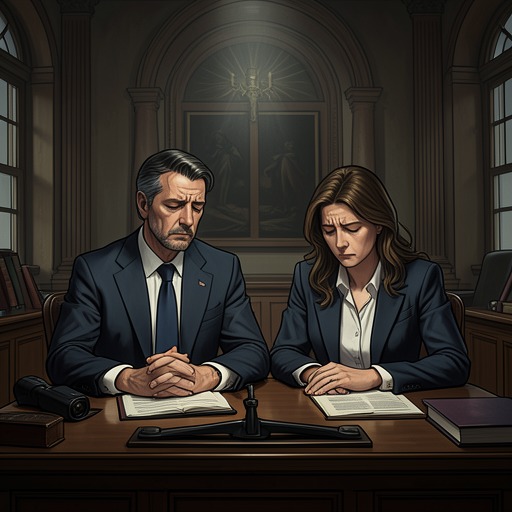
The concept becomes embodied in a woman Stevenson meets after a court hearing. She tells him that her sixteen-year-old grandson had been murdered by other boys. During their trials, she sat in court and cried every day for nearly two weeks. The boys were convicted and sent to prison forever, but their punishment did not relieve her grief; she felt worse. After sentencing, an unknown woman sat with her, hugged her, and let her lean against her. For almost two hours they remained together, much of the time in silence. The bereaved grandmother never learned the stranger’s identity, but remembered that she had made a difference simply by staying beside her.
That memory shaped what the grandmother did in court. At first, she looked for people who had lost someone to murder or another violent crime. Then she noticed that some of the people grieving most deeply were parents whose children were on trial. She began letting anyone who needed support lean on her. Her compassion crossed the lines that the courtroom drew between victims’ families and defendants’ families; she did not confuse their situations, but recognized pain on both sides of the proceedings.
The grandmother describes this work as catching stones people cast at one another. When she realizes Stevenson has also spoken about stonecatching, she identifies him as someone who tries to do the same. Her gesture makes the image physical: she rubs his palms and tells him that catching stones hurts. Stevenson has come to court to help Robert Caston and Joshua Carter, and is preparing for a drive of nearly five hours back to Montgomery once their matters are settled. In the midst of that work, the woman holds him and lets him lean on her. The act of care is reciprocal: the person who has spent years supporting others offers support to the lawyer, too.
Grief, sorrow, and the people harmed by violence
The courthouse scene does not reduce compassion for accused people to indifference toward victims. Elsewhere, the mother of a victim of Herbert Richardson’s bombing tells Stevenson that her family had been promised help but had not received it. She describes lasting injuries among the family: the victim’s sister has hearing problems dating from the bombing, another sister has nerve problems, and she has problems too. She approaches the lawyer representing Richardson because her family still needs assistance. The encounter makes visible a need that can be neglected when a case is treated only as a contest between prosecution and defense. Stonecatching must include attention to people who have been harmed and to the concrete needs that remain after violence.
The account of Ian Manuel and Debbie Baigre offers another difficult instance of care across the consequences of a violent crime. On Christmas Eve in 1992, after arriving in prison, Manuel used his monthly phone call to apologize to Baigre, the woman he had shot. His remorse led to regular correspondence. Baigre had recovered physically and pursued her own goals, but she also became one of the few people encouraging Manuel during years of isolation. After communicating with him for several years, she told the judge that his sentence was too harsh and his confinement inhumane. She acknowledged the destructiveness of his crime while insisting that Manuel had been a thirteen-year-old boy without supervision or help. The courts did not reduce his sentence. Her advocacy shows that compassion can take the form of sustained attention and a demand for humane treatment, without erasing the harm she suffered.
Mercy, sorrow, and continuing work
The grandmother does not present stonecatching as an easy or painless virtue. She tells Stevenson that the work teaches a person to appreciate a sorrow song: even happy songs can make someone sad after a life spent catching stones. Yet sorrow is not the end of the practice. She encourages him to keep singing, because the songs may make him strong and may even make him happy. The image holds grief and endurance together; it does not promise that acts of care will undo what has happened.
Stevenson connects the practice to what McMillian taught him about mercy. McMillian forgave people who had falsely accused him, convicted him, and judged him unworthy of mercy. For Stevenson, mercy is just when it is rooted in hope and freely given, especially when directed toward people who have not earned it or even asked for it. Stonecatching gives that principle a communal form: instead of demanding that the vulnerable bear every blow alone, people can interrupt condemnation and make room for another person to recover dignity and possibility.
The idea remains part of Stevenson’s ongoing work at the Equal Justice Initiative, where he continues to represent people on death row, children prosecuted as adults, and incarcerated people who have been wrongly convicted or unfairly sentenced. He describes meeting stonecatchers along the way as a source of inspiration and a reason to believe that society can do better for accused, convicted, and condemned people—and for one another. In this sense, stonecatching is not a single courtroom gesture or a substitute for legal reform. It is a continuing practice of refusing to abandon people to punishment and grief, while still seeing the injuries that violence leaves behind.